Pages

Showing posts with label Science. Show all posts

Wednesday, July 22, 2020

Making lava lamps

We made lava lamps in summer school today. So cool and so easy!


1. Fill an 8 oz. water bottle about 3/4th full with vegetable oil.
2. Add water but leave a little room at the top.
3. Add 5-10 drops of food coloring.
4. Drop small  pieces of Alka-Seltzer tablets in.
5. When the bubbling stops, put on the cap.
6. Tip the bottle and watch the reactions!

Separator

Tuesday, October 18, 2011

Bones~ possibly broken and otherwise

Wow, I'm honored. My blog was nominated to the Top 25 Teacher Mom Blogs list on Circle of Moms.


I'd love it if you would click here and vote for me. You can vote once a day until November 8th!

We started studying vertebrates and invertebrates this week. We made circle maps with scientific observation drawings of live, model, or skeletal examples of each.

Can you guess? Yep, a cat!
Our terrific science teacher holding a great white shark jaw.
Horse!
Mr. Bones is always a hit!
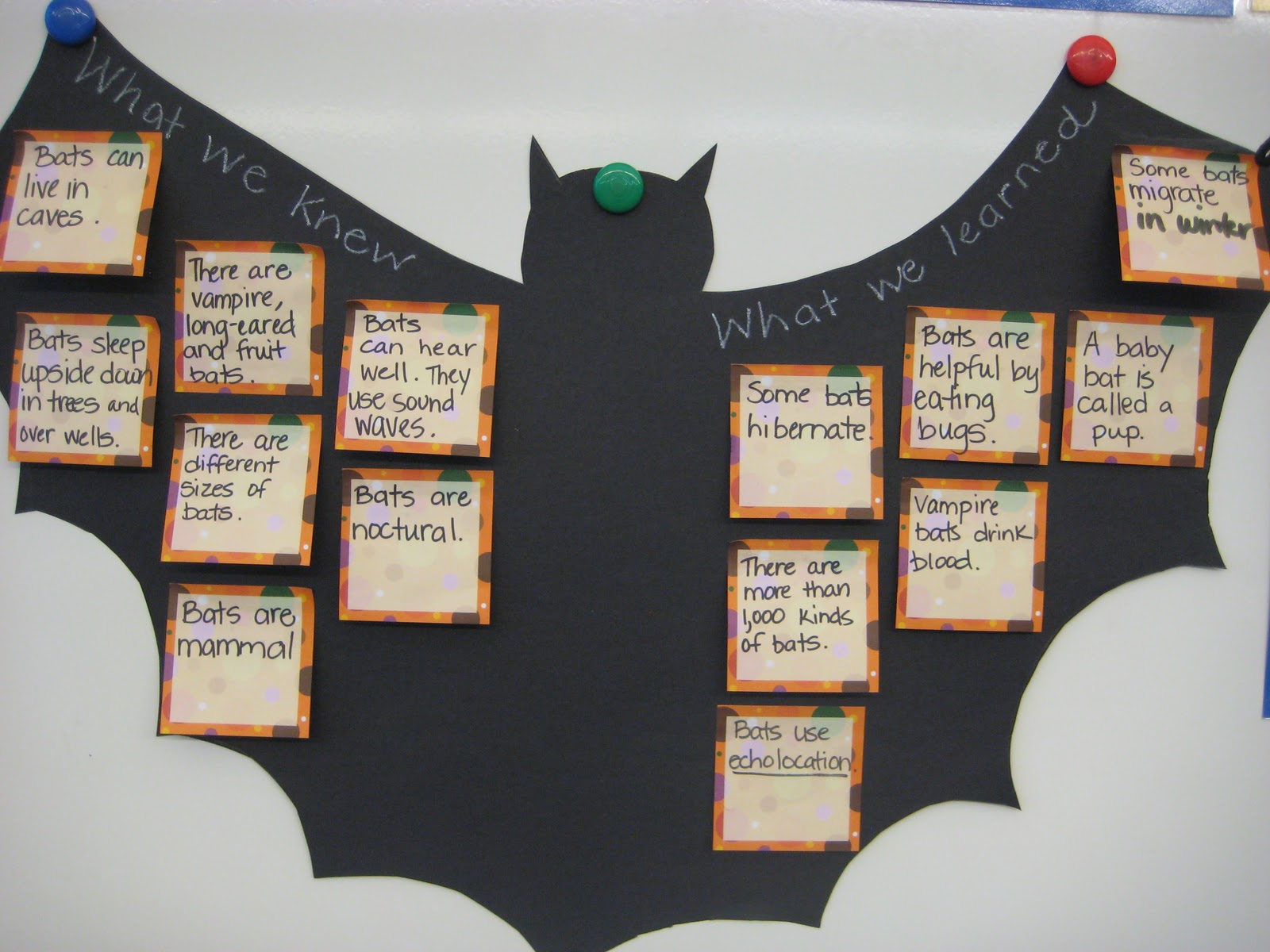
 This bat skeleton went perfectly with the nonfiction reading we did in the classroom. Going to a science school, my kiddos already knew quite a bit.


Pretty cool, huh! LOVE teaching at a school with an awesome science lab!

Alright friends, I am off to bed. My class this year is the most challenging I've had in quite a while and I am seriously spent every day. One of sweet girls went to the hospital with a possible broken arm after falling off the play structure at lunch today. I have been wondering how she is doing all night. The health aide sent her back to me with ice and I took one look at her and sent her right back!  I already have a boy with a broken leg on crutches that the kids fall over themselves to help so tomorrow could be interesting!

Separator

Sunday, March 13, 2011

What Do You Do With A Tail Like This?

We are still working on animal adaptions in science. In this lesson we read What Do You Do With A Tail Like This?
We have talked quite a bit about how animals have adaptations that help them survive in their environment. Students then got to create their our own mixed-up animal and draw the appropriate environment this animal would have the adaptations to survive in.

Animals from the book were copied on different colored paper  based on their adaptations.
All the cards were face down on the table. Students were directed to first take a blue card. What ever mouth that animal had they drew on their paper. Then they picked a white card and drew that animal's nose. And so on... until they had a new creature.
Then students added what the environment for this animal would be. If it had webbed feet, it must live around water, etc.

Notice the skunk spraying on this one.

 This smartie knew with those big eyes that her animal must be nocturnal!

You can tell by the coloring that we were a little rushed for time but they are still pretty cute.

Separator

Saturday, March 5, 2011

Flying Helicopters!

In science this week we learned about plant adaptations. Plants that live in dry, sunny areas have adaptations to conserve water. To keep cool the leaves may be small or thick. To reflect light, leaves may be gray, shiny, or fuzzy. Plants in shady, moist areas have adaptations to collect as much light as possible so their leaves are often large.

Students went on a walk around our outdoor science classroom to examine leaves to determine their adaptations.
Of course we saw a hummingbird near the Hummingbird Sage. :-)
Check out these adorable besties!
We also learned home Maple leaf seeds (Samaras) are spread  by acting like helicopters. Students made a simulated Samara and had a fun time "flying" them.


I scanned the Samara worksheet in for you. Sorry about the quality but it was one of those oldies passed down from previous teachers.

samaras


Separator

Saturday, February 19, 2011

Animal Adaptations

In science we are learning about animal adaptations. An animal's body parts are adaptations to help them survive in their environment. First, we talked about the fact that teeth are adaptations shaped to allow them to eat their food.


Carnivores or animal (meat) eaters have sharp, pointy teeth.
Herbivores or plant eaters have flat, wide teeth.
Omnivores or plant and animal eaters have both kinds of teeth.

The students then got to explore casts of various animal teeth.
Next, we talked about mimicry. Some animals copy others to help them avoid predators. 
The monarch eats milkweed which is poisonous and therefore is bitter-tasting to predators. The Viceroy looking very similar to the Monarch fools predators into not eating them.
Another mimicry example is the mountain king snake. We learned a little rhyme to help up remember which is poisonous:
RED TOUCHING BLACK IS A FRIEND TO JACK
RED TOUCHING YELLOW WILL KILL A FELLOW!

Then the students got to see and touch a real mountain king snake.
Last, we discussed camouflage as a means of survival. 
Can you find the walking sticks?
Then each student got to let one crawl on them. :-)
And that my friends, is why I LOVE teaching at an environmental science magnet!


Separator

Saturday, February 12, 2011

Gas Explosion

Nothing like starting science lab off with an gas explosion! Don't worry, it was only the soda and mentos experiment but it sure got the kids excited to learn about gasses today!

Of course the raisins in 7-up experiment is always a big hit.
We also let the kids put dry ice in water to see the CO2 being released.
Last, but not least, we talked about bubbles being gas surrounded by a thin layer of liquid so the kids went outside and blew bubbles with non-standard objects. Way cooler than regular bubble wands.

Separator

Monday, January 17, 2011

Water cycle and weather

We have been studying the water cycle and weather. We made up a water cycle chant complete with motions. Wish I had been smart enough to take a video for you.
 We made our own rain gauges.
Then we put them in an empty flower bed in our outdoor classroom.
After 2 weeks, we went back out to check our rain gauges. Boy, were they full!
Finally, we practiced using other weather tools like a wind vane
and a  thermometer
 and recorded our findings like a meteorologist!


Mr. Keedy, our awesome science teacher, demonstrated an anemometer
and then the kids got to make their own anemometer: a pinwheel! (OK, maybe that is a stretch because it doesn't measure the wind speed exactly but the kids liked it!)

Separator